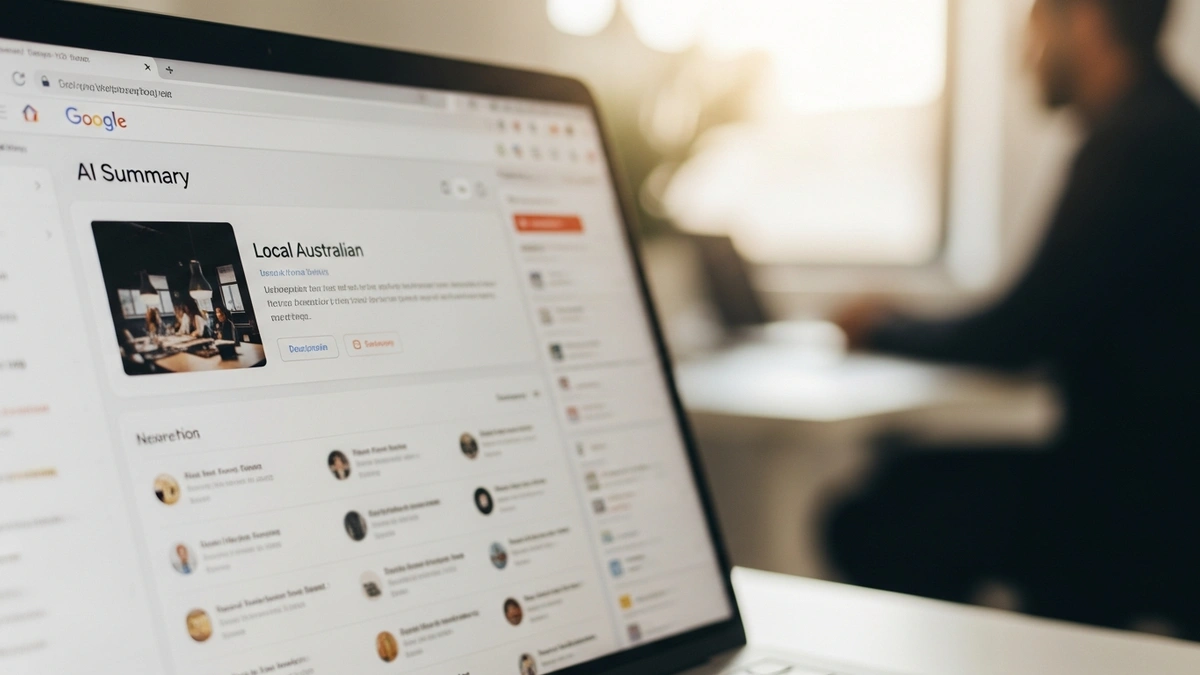
Google AI Overviews are the AI-generated summaries that appear at the top of Google search results — above the paid ads, above the Local Pack, and above every organic result you’ve spent years building. If you haven’t seen them yet in Australian results, you will. They’re rolling out globally and they’re changing how people interact with Google in a fundamental way.
Here’s what they actually are, how they affect your visibility, and what you need to do about it.
What Google AI Overviews Are (and Aren’t)
AI Overviews are not featured snippets. A featured snippet pulls a verbatim quote from a single page and displays it at the top of results. AI Overviews generate a synthesised answer by drawing from multiple sources simultaneously — and they cite those sources as links.
This is important for local businesses because it means being cited in an AI Overview is not winner-takes-all. Multiple businesses can be referenced in a single overview. A summary answering “What should I look for when hiring an electrician in Brisbane?” might cite three different sources, including a local business’s blog post, a consumer advice page, and an industry association.
The other key difference: AI Overviews can significantly reduce click-through rates on the organic results below them. If the AI Overview answers the question fully, many users won’t scroll further. Your content needs to be in the overview, not beneath it.
What Triggers an AI Overview
Not every search produces an AI Overview. Google currently shows them for queries that are informational in nature — questions, comparisons, explanations, “how to” searches, and “what is” searches. They appear less frequently for navigational queries (someone searching directly for a brand) or for purely transactional intent like “plumber near me.”
For local businesses, this means AI Overviews are most likely to appear when a potential customer is in the research phase. “How do I know if my hot water system needs replacing?” or “What does a building inspection include?” — these are the queries where an AI Overview surfaces, and where a business with strong educational content can be cited.
How Google Decides What to Include
Google’s AI Overview selection draws from its existing ranking infrastructure. Pages that rank well in organic search are more likely to be cited, but it’s not purely positional. Google is specifically selecting sources that demonstrate E-E-A-T: Experience, Expertise, Authoritativeness, and Trustworthiness.
For local businesses, this translates to several concrete factors:
Author credentials. Content attributed to a named individual with verifiable expertise carries more weight than anonymous copy. A post written by “Jack Sinclair, licensed electrician with 15 years experience” is a stronger E-E-A-T signal than “The Team at XYZ Electrical.”
Schema markup. Structured data helps Google understand exactly who created the content, what it’s about, and whether the business is legitimate. LocalBusiness schema, Article schema with author markup, and FAQPage schema all contribute to how confidently Google can assess your content.
FAQ content. AI Overviews frequently draw from FAQ sections because they’re structured as direct question-and-answer pairs — exactly the format AI systems are designed to process. Every service page on your website should include a section of genuine FAQs with specific, useful answers.
Content depth and specificity. Google’s AI is not going to cite a page that says “We provide professional electrical services across Southeast Queensland.” It will cite a page that explains the difference between a switchboard upgrade and a switchboard replacement, when each is appropriate, and what the process involves.
Structured Business Data Matters More Than People Realise
One underappreciated factor in AI Overview eligibility is the completeness of your structured business data. Google cross-references your website content against your Google Business Profile. If your GBP says you’re an electrician in Ipswich and your website has detailed content about electrical services in Ipswich, those signals reinforce each other.
Inconsistencies between your GBP data and your website content — different business name variations, mismatched service descriptions, address discrepancies — create uncertainty for Google’s systems and reduce the confidence with which they’ll cite you.
What to Do Right Now
Add FAQ schema to your service pages. Use FAQPage schema markup on any page that contains question-and-answer content. This makes the Q&A structure machine-readable and increases the likelihood of those answers appearing in AI Overviews.
Write educational content that answers specific questions. Identify the top five questions your customers ask before they book. Write a dedicated piece of content — a blog post, a service page section, a standalone FAQ page — that answers each one properly.
Attribute content to real people. Add author profiles to your blog posts and service pages. Include credentials. Connect author profiles using Person schema with verifiable links to social profiles or professional registrations.
Make sure your Google Business Profile and your website tell a consistent story. Same business name, same address format, same service descriptions. The more your online presence coheres, the more confidently Google’s systems can cite you.
AI Overviews are not going away. The businesses that adapt their content strategy now will occupy those citation spots when their competitors are still wondering why their organic traffic dropped.
Our AI Search Optimisation service covers the full scope of what’s needed — content strategy, schema markup, GBP alignment, and citation building — built specifically for local businesses.