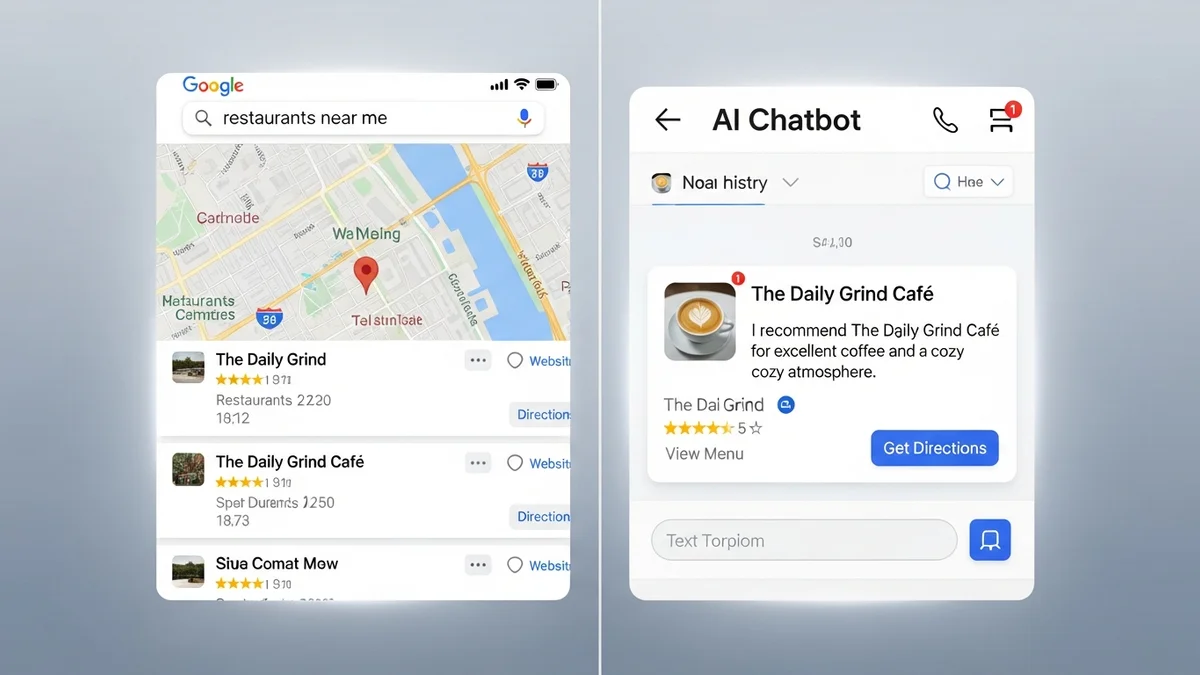
Traditional search is straightforward: type a query, get a list of ten blue links ranked by relevance. AI search is different. Instead of presenting options, it gives answers — and the businesses it names in those answers aren’t chosen randomly.
Understanding how these platforms make their decisions is the first step to being included in them.
The Two Types of AI Search
Not all AI search platforms work the same way. There are two distinct mechanisms at play, and knowing the difference matters for how you approach optimisation.
Training data models — like the core ChatGPT model — were built on large datasets of internet content collected up to a cutoff date. When you ask a question, the model draws on patterns embedded during training. Businesses that were well-documented across the web before that cutoff have an advantage. Businesses that weren’t are effectively absent.
Retrieval-augmented generation (RAG) systems — used by Perplexity and by ChatGPT’s Search feature — combine a language model with live web retrieval. When you ask a question, the system searches the web in real time, pulls relevant pages, and generates an answer based on what it finds. This means current, well-structured content on your website has a much more direct path to inclusion.
Google AI Overviews operate similarly to RAG: they retrieve and synthesise current content from the web, but they’re deeply integrated with Google’s existing ranking infrastructure — which means your Google Business Profile and your site’s authority in Google’s index both feed directly into what gets cited.
Why Google Business Profile Still Matters
Google Business Profile (GBP) is not just a map listing. It is one of the most structured, verified sources of local business data that Google and other AI platforms can access. Your business name, category, address, services, opening hours, and reviews are all machine-readable in a consistent format.
When Google AI Overviews generate a local business recommendation, GBP data is a primary input. When other AI platforms retrieve information about local businesses from the web, they frequently pull from sources that themselves rely on GBP data.
An incomplete or outdated GBP is a direct liability in AI search, not just in traditional map results.
How Authority Signals Feed AI Recommendations
AI platforms are not simply retrieving the closest result. They’re assessing credibility. The signals they look for include:
Review volume and recency. A business with 12 reviews from three years ago signals lower activity and confidence than a business with 80 reviews, many of them recent. AI systems — particularly those with live retrieval — factor recency heavily.
Citation consistency. When your business name, address, and phone number appear consistently across multiple authoritative directories, that agreement between sources increases the signal strength for AI systems. One strong listing is good. Twenty consistent listings across credible directories is substantially better.
Content that directly answers questions. AI systems are designed to answer questions. Businesses whose websites contain clear, specific answers to the questions their customers ask are more likely to be retrieved and cited. A plumber’s website that explains what causes a blocked drain, how to prevent one, and what the repair process involves is a much more useful source for an AI than one that simply lists services.
What “AI-Readable” Content Actually Means
You’ll hear the term “AI-readable content” used loosely. In practice, it refers to a few specific things.
Structured markup. Schema.org vocabulary (added as JSON-LD code to your website) lets you explicitly declare your business type, location, services, and operating hours in a machine-readable format. This removes guesswork for both search engines and AI platforms.
Clear question-and-answer formatting. Content written in a format that mirrors how people ask questions — with a clear question as a heading and a direct answer in the paragraph beneath — maps cleanly onto how AI systems retrieve and synthesise answers.
Specificity over vagueness. “We offer a range of plumbing services” is not useful to an AI trying to answer “Who does hot water repairs in Ipswich?” A page explicitly titled “Hot Water System Repairs in Ipswich” with detailed content about the service is directly useful.
The Practical Takeaway
For local business owners, the shift to AI search does not require abandoning everything you know. The fundamentals of local SEO — a complete GBP, consistent citations, genuine reviews, and useful content on your website — are still the foundation.
What changes is the emphasis. In traditional SEO, you were optimising to rank. In AI search, you’re optimising to be cited. That means your content needs to be the kind of source an AI platform would confidently quote — specific, accurate, consistently supported by your broader web presence, and formatted in ways that machines can parse efficiently.
The businesses that figure this out now are building an advantage their competitors will struggle to close.
For a practical breakdown of how the two approaches differ, read Local SEO vs AI Search Optimisation.