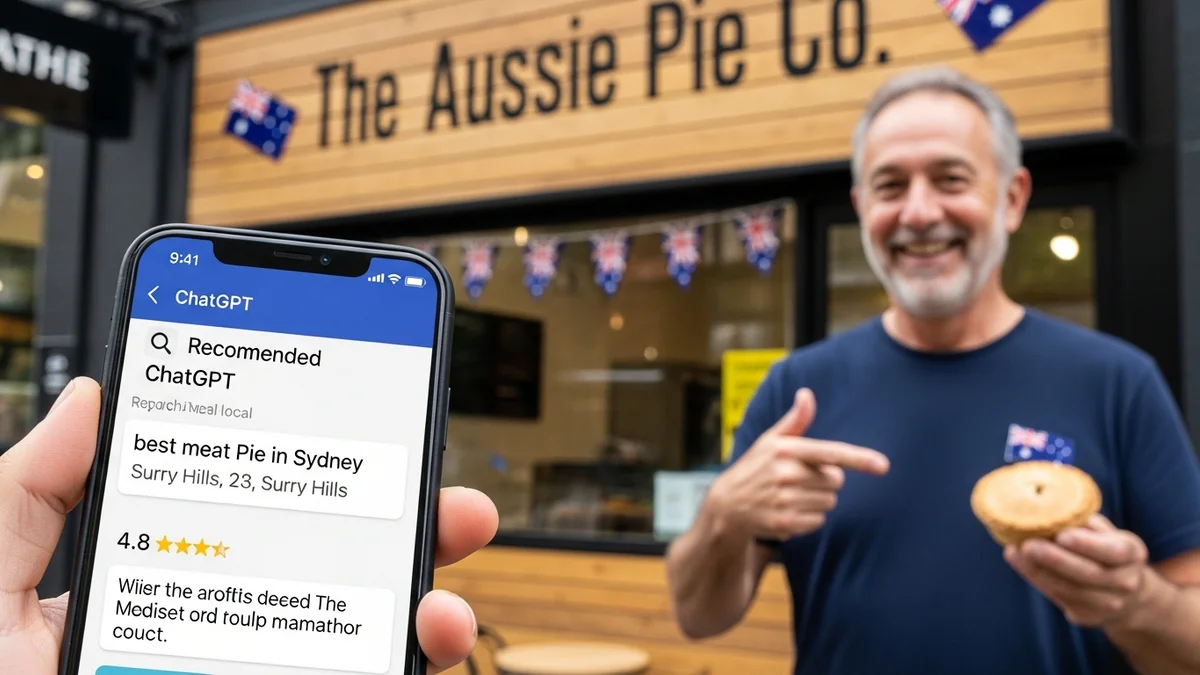
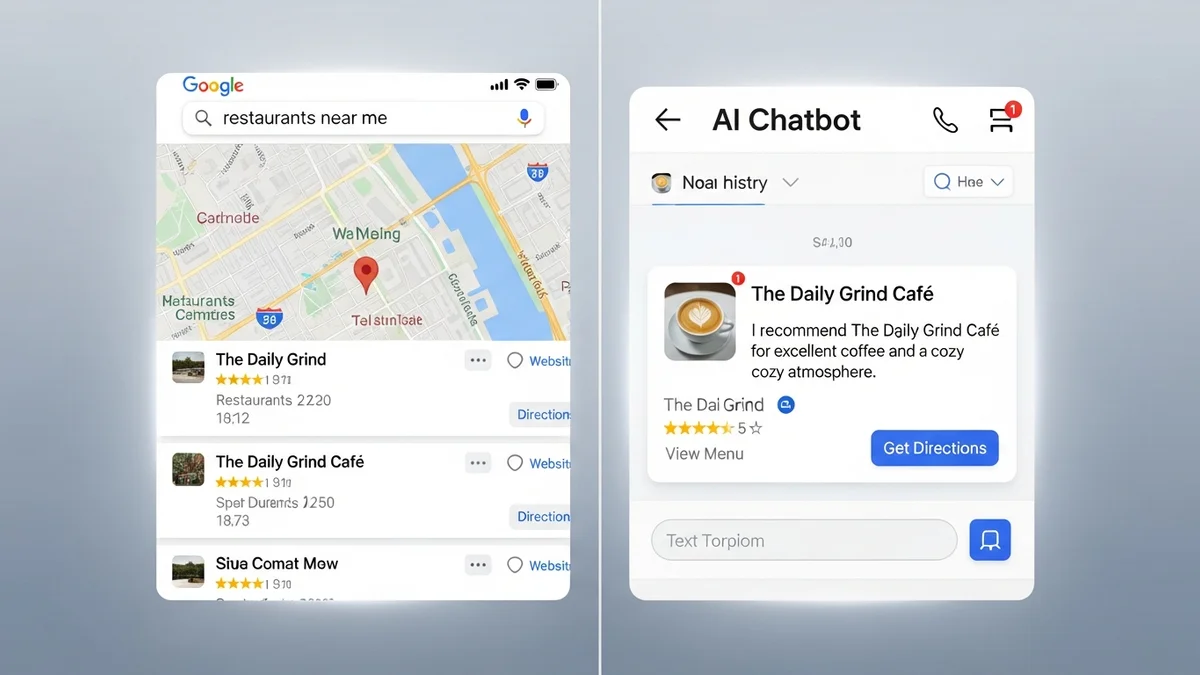
Someone in your service area opens ChatGPT or Perplexity and types “best [your service] in [your city].” Will your business come up?
For most local businesses, the answer right now is no. Here’s how to change that.
Before you optimise for anything, understand the mechanism you’re optimising for. ChatGPT and Perplexity are meaningfully different in how they produce local recommendations.
ChatGPT (the core model, not Search mode) draws on training data — content from across the internet captured before a cutoff date. Businesses that had a strong, well-documented presence in that data are more likely to surface. Businesses that were absent or inconsistently documented are not. Updating your website today will not immediately appear in the base ChatGPT model’s responses, but it does feed into future training cycles and into ChatGPT’s Search feature, which retrieves live web content.
Perplexity uses real-time web retrieval. It searches the web at the moment of the query, pulls relevant sources, and generates an answer based on what it finds. This means current, well-structured, publicly accessible content on your website has a direct and relatively immediate path to being cited.
ChatGPT Search (the web-browsing mode) works similarly to Perplexity — live retrieval, current content, cited sources.
The practical implication: content you publish today can influence Perplexity and ChatGPT Search results within days or weeks. Influencing the base ChatGPT model is a longer game, built on establishing consistent web presence over time.
Publish Question-Answering Content — and Format It Correctly
AI platforms are, at their core, answer engines. They retrieve sources that answer the question being asked. Your website needs to be one of those sources.
This means writing content structured explicitly around the questions your potential customers ask. Not “Our Plumbing Services” — but “How long does a hot water system installation take?” and “What are the signs that my drainage system is failing?”
Format matters. Structure these as a clear heading (the question, written exactly as someone would ask it) followed by a direct, specific answer in the first one to two sentences of the paragraph. Don’t bury the answer in paragraph three. AI platforms retrieve content by matching query to answer — make that match easy.
A dedicated FAQ page works well. So do service pages that incorporate an FAQ section. Blog posts structured as question-led articles perform strongly in Perplexity because they mirror the query format directly.
Get Cited in Authoritative External Sources
Being mentioned on your own website is not enough. AI platforms weight external citations heavily — particularly from sources with established authority in their subject area.
For Australian local businesses, the external citations that matter most include:
- Industry directories with genuine authority — not random link-farm directories, but platforms like Hipages, Oneflare, your trade association’s member directory, or a state government business register if applicable
- Local and regional news — if your business has been mentioned in a local newspaper article (print or digital), that mention carries real weight
- Trade associations and professional bodies — being listed as a member of your relevant industry body (Master Builders, NECA, APA, etc.) is both an authority signal and a structured citation
- Community organisations — sponsoring a local sporting club, having your business mentioned on a council website, appearing in a Chamber of Commerce member directory
The key distinction between useful citations and useless ones: contextual mentions beat bare listings. A paragraph in a local news article that names your business, describes what you do, and links to your website is far more valuable than a directory entry that’s just your name and phone number. Context tells AI platforms not just that you exist, but what you are and why you’re relevant.
AI platforms assess authority partly through social proof signals. Review volume and recency across multiple platforms signal that your business is active and trusted.
The platforms that matter for AI search purposes:
A business with 15 reviews, all from three years ago, reads as inactive to both AI systems and potential customers. A business with 80 reviews, with several added each month, reads as established and currently operating.
One frequently overlooked tactic: review responses. When you respond to a Google review and naturally include your service type and location, that response content is indexed and readable by AI systems. Forty reviews with thoughtful, service-specific responses is better than 80 reviews with no responses at all.
Structured Data on Your Website
Perplexity and ChatGPT Search both retrieve and parse web pages. When your website includes LocalBusiness schema markup, you’re providing these systems with a directly machine-readable declaration of your business name, location, service type, and contact details — rather than requiring the AI to infer this from your written copy.
Add LocalBusiness JSON-LD to your homepage and contact page at minimum. Add Service schema to each individual service page. Add FAQPage schema to any page with question-and-answer content.
This doesn’t guarantee inclusion, but it removes friction. AI platforms favour sources they can parse with confidence over sources that require significant inference.
Being Mentioned in Context, Not Just Listed
There’s a difference between being listed and being cited. A bare directory entry says you exist. A paragraph in a trade publication that explains your approach to a specific problem, attributes insights to you by name, and links to your website says you’re an authority.
AI systems pick up on this distinction. The more your business is mentioned in context — as the subject of a recommendation, as the source of expert advice, as the business someone specifically names when describing a positive experience — the more those contextual signals accumulate into genuine authority.
This is why PR activity, industry association involvement, and even encouraging specific rather than generic reviews (“Jack sorted out our stormwater drainage issue in one visit — we’d been getting quotes for months”) compounds over time in ways that a directory listing never will.
Getting recommended by ChatGPT and Perplexity is not a single tactic. It’s a system of overlapping signals. Build the system, and the recommendations follow.
If you’d like help building that system for your business, start with an AI Visibility Audit to understand your current position — then we can build the strategy from there.